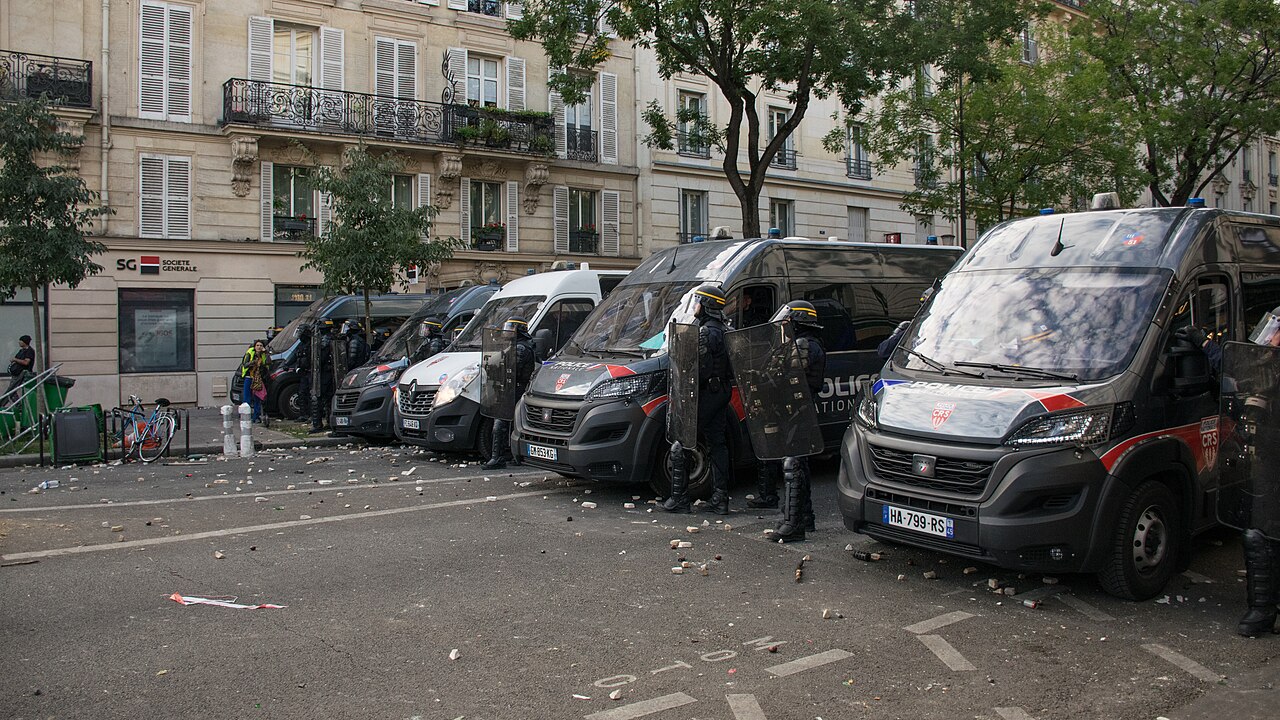
On Oct. 6, 2026, students and supporters filled streets across France, turning school-resource grievances into a nationwide political scene — a day before the authorities announced a suspension of police stun grenades on Oct. 7. A year earlier, on Sept. 25, 2025, a prophetic YouTube message titled “ROSH HASHANAH PROPHECY: I Saw The Year 2040 and We Were Still Here” had used a line that now reads differently in hindsight: “a disenfranchised group began to rise up and demand change.”
For a newcomer, this is the story of how a youth-led protest wave in France — involving high school students, unions and broader public sympathy — suddenly made an older dated word feel newly specific. The question is not whether a prophecy can be forced onto current events, but why this one now appears to touch a very concrete social movement in a country known for mass demonstrations, civic pressure and fast-moving political symbolism.
THE ORIGINAL WORD
The dated source at the center of this story is a YouTube recording posted on Sept. 25, 2025, at Watch the original prophecy ↗. In the upload titled “ROSH HASHANAH PROPHECY: I Saw The Year 2040 and We Were Still Here,” the archived line is: “a disenfranchised group began to rise up and demand change.”
< Even so, the wording is plain enough to invite scrutiny. It describes not a vague mood but a social category — a disadvantaged group — moving from grievance into open demand. That is why the France protests matter here: they give the sentence a lived political shape.THE WORD / REAL HISTORICAL RECORDING
Hear the original prophecy, in context.
Published 25 September 2025. This is the original source video, not an AI narrator and not an artificial recreation. The written report provides the news and its explanation.
ORIGINAL PROPHECY · WATCH IN CONTEXT · 5:04–6:40
This excerpt begins just before the original recorded wording. Watch it in context or open the full unedited recording.
▶ Open contextual excerpt on YouTube ↗ FULL UNEDITED RECORDING ↗WHAT HAPPENED
The French unrest developed in stages rather than in one single burst. According to the candidate chronology, the protest movement began on Sept. 21, 2026, as students mobilized around education funding, school resources and their treatment by police. By Oct. 6, the movement had expanded into a nationwide march, with students and supporters visible in multiple cities and the issue no longer confined to campus life. The unrest then drew a further state response: Reuters reported on Oct. 7 that France suspended the use of stun grenades by police in the context of student protests, a sign that the demonstrations had become serious enough to trigger changes in crowd-control practice.
The broader background matters. France has a long history of street protest, but youth-led movements carry particular symbolic force because they often pull family, labor and political constituencies into the same frame. In this case, the issue was not an abstract ideology but school resources and the experience of being pushed aside — the kind of complaint that can broaden from students into a national argument about fairness, public spending and authority. Meanwhile, the archived prophetic message had been published more than a year earlier, on Sept. 25, 2025, making the chronology notable: the dated word preceded the visible public escalation by a substantial margin. The 2026 setting in the original context also mentioned France and England, political turbulence and populism, which is why this protest wave now draws attention.
THE CORRESPONDENCE
What makes the comparison compelling is not that every detail matches, but that the core motion does. The archived sentence speaks of a disenfranchised group rising up and demanding change; the French developments show a youth-led constituency moving from complaint to coordinated public action. The correspondence is social, chronological and political. A reader can see the overlap without special pleading: young people, grievances, public mobilization, pressure on state institutions, and a movement large enough to force official response.
The significance is not merely literary. If the prophetic wording was meant to point toward an identifiable public uprising in a Western setting, France in 2026 gives it concrete texture. The country’s students were not isolated voices; they became visible actors in a wider civic moment. That makes the phrase “demand change” especially resonant, because the protests were not just symbolic dissent but an attempt to alter how schools and police interact with young citizens. Still, the passage remains only partially specified, and the exact referent of “disenfranchised group” is not nailed down by the sentence alone.
THE QUESTIONS WORTH ASKING
The strongest competing reading is that the wording is broad by design. “A disenfranchised group” could describe many populations in many places, and France’s history of recurring protest makes a later youth movement feel less surprising than it might in a quieter country. The original context, which references France and England plus political turbulence and populism, is also wide enough that the line may have been intended as a general social forecast rather than a pinpointed forecast of high school protests.
There is also a substantive mismatch: the unrest in France centered on school funding, resource questions and police conduct, not on a clearly identified disenfranchised political bloc in the narrow sense. And while the candidate chronology includes military-related national debates in the broader context, the current protest sequence does not prove any direct connection to conscription or wartime maneuvering. Those limits matter. They do not erase the correspondence, but they keep it from being overstated.
WHAT TO WATCH NEXT
The next things to watch are whether the French protests widen beyond students, whether labor unions or other public groups keep joining, and whether the government’s response deepens or cools the unrest. If the movement remains centered on education and policing, the prophetic overlap stays focused on one kind of social pressure: the rise of a disadvantaged group into national visibility. If, however, the protests merge into broader political agitation over fairness, austerity or authority, the resonance grows stronger still.
Readers should also watch the source itself. A manual check of the exact audio boundary would clarify whether the archived caption reflects the intended spoken line with full confidence. But even before that final review, the dated wording already earns attention because it landed ahead of the event it seems to echo. France has given the sentence a face, a street and a calendar date. That is enough to make the moment worth serious watchfulness.